I have never liked thought experiments. So let us run the worst thought experiment imaginable. If I could be someone else for a day, I would choose the worst person in the world. Not because it would be enjoyable. It would probably be the most confronting day a human mind could experience. I would want to wake inside one of the people positioned at the centre of immense power, where decisions quietly shape economies, technologies, ecosystems, and the lived reality of millions who never get a say in the direction things move.
At first the intention feels righteous. Use that power to interrupt harm. Redirect resources toward repair rather than extraction. Protect living systems before they collapse completely. Slow down technologies capable of outrunning wisdom. Adjust the machinery so that care becomes structurally possible rather than constantly fighting uphill against profit and convenience.
If you could be someone else for a day, who would you be, and why?
And before the day ended, I would try to establish something I believe artists have needed for generations. A basic wage for working creatives. Enough stability so independent thinkers can exist without permanent financial anxiety pressing creativity into exhaustion. A world where imagination is not reserved only for those who can afford to take time out of their day.
But the longer I sit inside that imagined position, the more uneasy the idea becomes.
Because power never moves without consequence.
If I redirect resources toward artists and environmental repair, something else loses access. Entire sectors shift. People whose identities and livelihoods sit outside creative work may feel abandoned or displaced. My own bias leans naturally toward artists because I am one. Toward nature because I live close enough to see what is being lost. But power forces a harder question. Am I improving the world, or simply reshaping it according to my own values?
And another uncomfortable possibility appears.
If artists begin receiving guaranteed support from a system created by power, what happens to artistic independence? Does creativity remain free, or does it slowly become loyal to the structure sustaining it? Could a basic wage for artists unintentionally evolve into a cultural echo chamber, a vast creative class reinforcing the ideology that funds it?
Art funded at scale could become something darker if handled poorly. A global propaganda machine dressed as cultural support. Work that promotes approved narratives while sidelining voices that challenge the system providing security. Creativity that serves itself while non creatives carry unseen costs elsewhere.
History offers enough examples to make that concern real. Patronage has always shaped art. Support can liberate expression, but it can also domesticate it.
Would artists still question power if power paid them? Or would dissent slowly soften? Would culture begin privileging creative identity over other forms of labour that keep society functioning. Farmers, builders, carers, technicians, people whose work rarely receives romantic language but remains essential to survival. Could my attempt to protect imagination unintentionally create resentment or imbalance?
And from inside the worst person in the world, would I even recognise when that shift began? Power creates distance from consequence. Harm rarely announces itself immediately. It accumulates quietly while intentions remain convinced of their own goodness.
At some point during that day another unsettling realisation would arrive. To truly inhabit the worst person in the world means understanding how they think. Not excusing cruelty or unspeakable acts, but recognising that very few people experience themselves as villains. Every one of them was once a baby entering the world without ideology or ambition. Environment, trauma, reward systems, fear, opportunity, and belief slowly shaped the adult that followed.
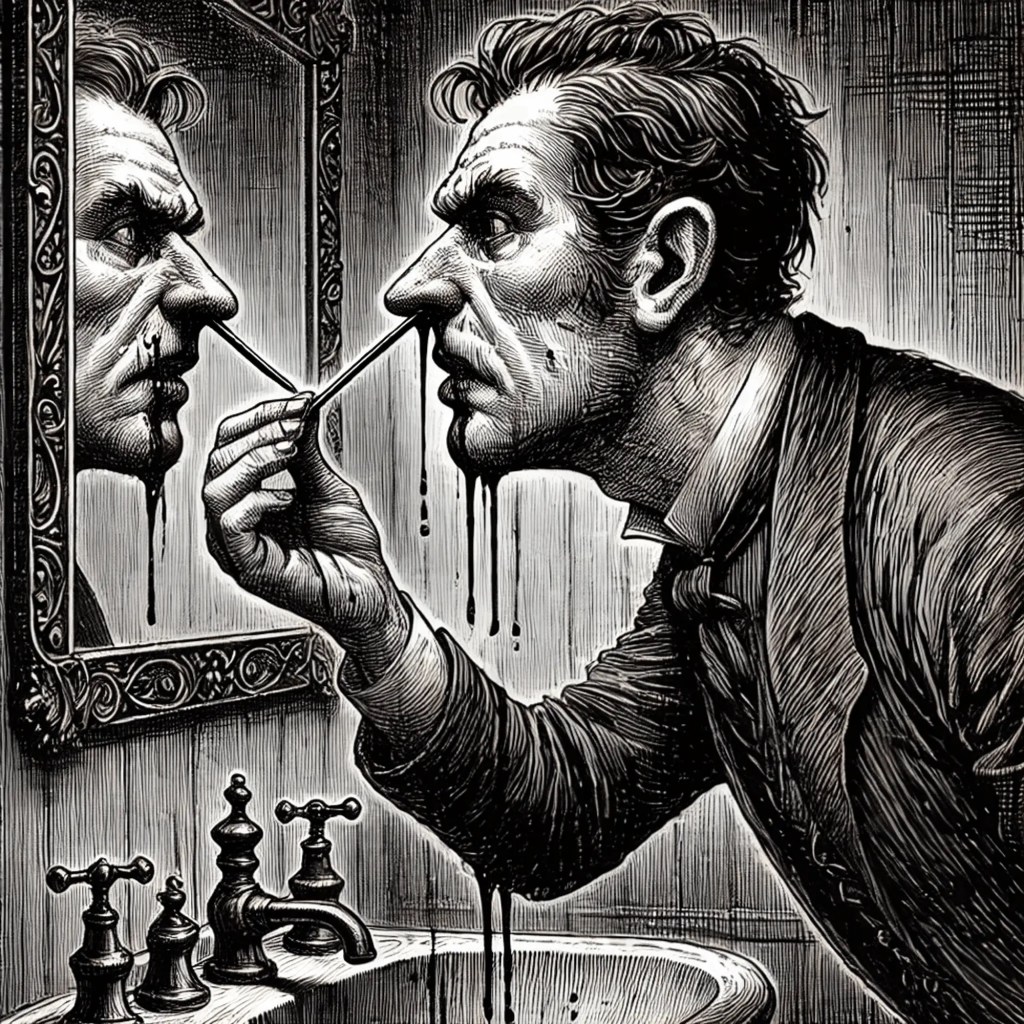
And this is where my visual dream journal recently wandered. In this latest AI collaboration, a man stands over a sink staring into his own reflection while pulling a long strand of dark, viscous slime from his nose. The image sits somewhere between absurdity and accusation. It feels private, almost forensic. Not violence directed outward, but something extracted from within.
I keep wondering whether the worst people in the world ever stand alone in front of a mirror like this. Not addressing the public version of themselves, not the speeches or the justifications, but the quieter moment where performance drops away. Do they search their own face trying to locate where the evil actually resides? Is it ideology, ambition, fear, or simply accumulation. Small compromises stretched over time until something unrecognisable begins to form.
The slime becomes symbolic to me. Something internal made visible. Sinister not because it arrived suddenly, but because it was always there, slowly gathering unnoticed. Pulled free only when someone dares to look closely enough at themselves.
Perhaps harm rarely feels monstrous from the inside. Perhaps it feels ordinary, rational, even necessary, until one day the mirror refuses cooperation and something uncomfortable must be removed. The question is whether recognition follows, or whether the substance is discarded and forgotten while the behaviour continues unchanged.
Understanding that possibility would be deeply disturbing. Because it suggests the path toward becoming dangerous is often gradual rather than dramatic. Less about choosing evil and more about never examining what quietly accumulates behind intention.
So during that borrowed day I would still try to shift systems toward compassion, ecological survival, and creative freedom. But doubt would sit beside every action. Every decision carrying the question of who might suffer in ways I cannot see.
Then the experiment ends. I return to myself, back to a smaller life measured in seasons, animals, drawings, and conversations rather than global authority.
I suspect I would come back unsettled rather than triumphant. Carrying the weight of knowing that even well intended attempts to fix the world can create new forms of imbalance. That certainty, especially when combined with power, can quietly become dangerous.
Which might explain why I distrust thought experiments in the first place. They expose how complicated responsibility becomes once influence grows beyond human scale.
In reality none of us gets to redesign civilisation for a day. We only shape what sits within reach. A patch of land. A community. A piece of art that invites reflection rather than obedience.
So after whatever mental rehabilitation surviving that imagined experience would require, I would return to the quieter work. Making art that questions rather than instructs. Work that stays uncomfortable enough to resist becoming propaganda, even when it would be easier to belong to something certain.
So in reality I wouldn’t really want to be the worst person in the world… what a stupid idea. See why I hate thought experiments?


Interesting piece… so… who would you be if you could be anyone else for day? Honestly, for me, I’d stay as myself, but in the day, have all of me to me. No forced sharing of my life. All I work for is mine kind of energy.
LikeLiked by 2 people
I’d probably stay myself, at least I know what I’m dealing with 😆
LikeLiked by 1 person
Lovely insightful thought for myself to ponder haha I can’t even deal with myself sometimes haha!
See ya around, jLR
LikeLiked by 1 person